
Specific Polygons
A "specific polygon " is already placed on the xy-coordinate plane and the coordinates of its vertices are known.
Example:
The vertices of a quadrilateral are A(0, 0), B(2, 6), C(10, 12), D(8, 0):

Prove that the quadrilateral formed by joining the midpoints of its sides is a parallelogram.
Solution:
We use the midpoint formula to find the coordinates of the midpoints and draw the quadrilateral that joins the midpoints. Call this quadrilateral MNPQ:
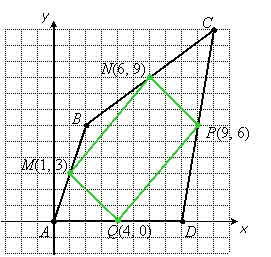
To prove this quadrilateral is a parallelogram, we show pairs of opposite sides are parallel. All we have to do is show their slopes are equal:


Since these are the same, we know side MN is parallel to side PQ. We must also show side MQ is parallel to side NP:


Again the slopes are equal, so side MQ is parallel to side NP, and therefore quadrilateral MNPQ is a parallelogram.
Content ©2008. All Rights Reserved.
Date last modified: October 14, 2008.