
- Next
- Page 1 of 4
Introduction to Coordinate Proofs
An isosceles triangle is a triangle with two congruent sides. For example, the triangle with vertices A(0, 0), B(4, 10), and C(8, 0) is isosceles:

If we want to be absolutely sure, we could prove it is isosceles by using the distance formula to show the lengths of sides AB and BC are equal:


This might seem like killing a fly with a sledge-hammer. After all, B's x-coordinate is halfway between A's and C's, and the picture makes it clear.
Suppose we draw segments from vertices A and B to the midpoints of their opposite sides:
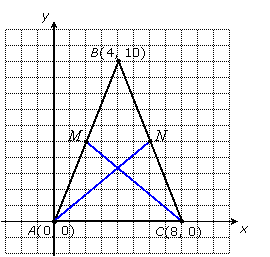
These segments are called medians of the triangle, and also happen to be congruent.
The coordinates of the midpoints are:


The lengths of the segments are:


So these two medians are congruent.
This suggests that the two medians connecting the congruent sides of any isosceles triangle might be congruent. To prove that assertion, we need to consider a more general isosceles triangle. No matter what triangle we consider, we can call the base-length 4b, (we can choose 4 times a number so midpoints will come out easier) and we can place the base along the x-axis with one vertex at the origin and the other at (4b, 0). In our above triangle, the base-length was 8, so b = 2. The third vertex will have coordinates (2b, something), and we can make the "something" equal to 2c, where c is some number:
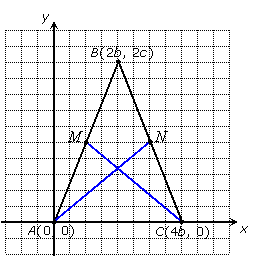
Then the midpoints (by the midpoint formula) have coordinates: M = (b, c) and N = (3b, c). Now we can use the distance formula to prove that AN = CM:


The idea behind a coordinate proof is to place the figure in question on the xy-plane at a convenient location, and assign general coordinates (with variables) to its important points.
Content ©2008. All Rights Reserved.
Date last modified: October 14, 2008.