
Proportional Segements
The Triangle Angle-Bisector Theorem gives a simple result about how an angle bisector cuts the opposite side in a triangle, and follows from the Proportional Segments Theorem (a result about parallel lines cut by a transversal). Recall that if lines L1, L2 and L3 are parallel and cut by transversals L4 and L5, then the segments on these transversals are proportional:

To see how this result relates to the bisector of an angle in a triangle, extend parallels at the other vertices (at A and C, where  bisects
  ):
):
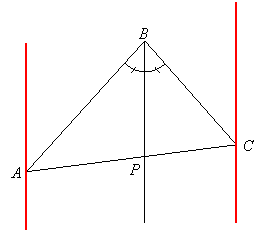
Then extend one of the sides adjacent the bisected angle until it meets both parallels.
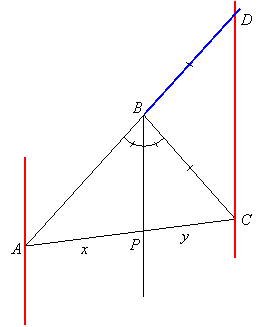
By properties of parallel lines (alternate interior angles and corresponding angles) it is easy to show that  , so BC = BD (by the Isosceles Triangle Theorem).
In the diagram,  and
and  are transversals cut by the 3 parallel lines, and
so  . Since BD = BC, this gives:
  . That is, the bisector of an angle of a triangle splits the opposite side into segments with the same proportion as the adjacent sides.
Content ©2008. All Rights Reserved.
Date last modified: August 5, 2008.